Home Office Gym Combo: One Small Room, Two Full-Time Jobs
Your spare room is 10 × 11 feet and it owes you a career and a fitness habit. Here's how to zone it so the desk stays work, the corner stays training, and neither one slowly eats the other.
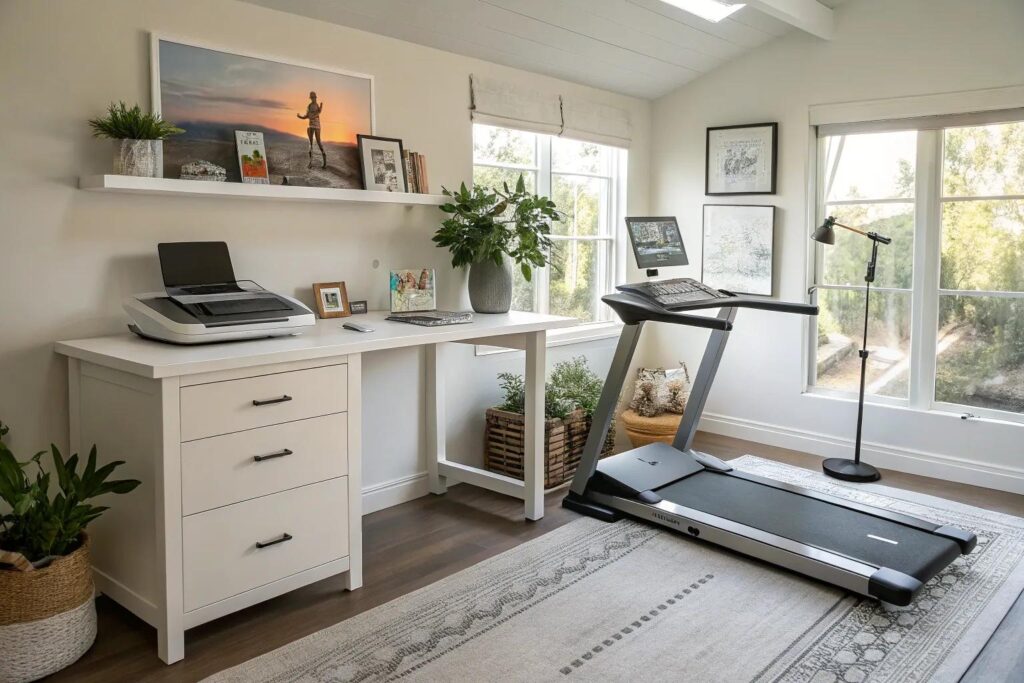
If you work from home in a small place, you already know the geometry problem by heart. The desk annexed the spare room. The "gym" is a mat leaning against the wall and a pair of dumbbells living under the desk like they're hiding from rent. Every workout starts with moving office stuff and ends with your workspace smelling faintly of effort, and every workday happens within arm's reach of the equipment that quietly reminds you you haven't trained since Tuesday.
Now picture the same room with rules. You sit down at a desk that's purely a desk — clear surface, chair, screen, nothing squeaking in your peripheral vision. At lunch you take four steps, unroll nothing (the mat lives flat in its zone), and train for twenty honest minutes in a corner that needs zero setup. When you're done, the corner goes quiet again and the room gives the desk its focus back. One small room, doing two jobs without either job feeling like the other's storage unit. That's a home office gym combo done right, and it's mostly zoning, not shopping.
This guide expands the layout thinking from our small-space gym layouts article and the Desk Flip plan in the pillar guide, specialized for the room that also has to hold your job.
The three rules that make one room work
- Rule 1: The desk zone never stores gym gear. Nothing fitness-related lives on, under, or beside the desk except (optionally) an under-desk pedal, which is office equipment by behavior. The moment dumbbells camp under the desk, the desk becomes a gym that also has email — and both jobs degrade.
- Rule 2: The training zone needs zero setup. Your mat stays flat or rolled in its corner; weights live in their stack. If starting a workout requires moving office furniture, it won't survive a busy week. Target: from "I should train" to first rep in under 60 seconds.
- Rule 3: One ritual flips the room. A two-minute end-of-work sequence — laptop closed, chair rolled to its parking spot, training shoes on — is the boundary between jobs. Rooms don't switch modes on their own; rituals do.
Zoning a 10 × 11 room, in feet
Work in zones with real dimensions, not vibes. In a typical 110 sq ft spare room:
- Desk zone (~5 × 3 ft against a wall): desk 48–55 inches wide, chair with ~2 ft of roll-back, monitor arm if you can — it returns 6 inches of desk depth and reads instantly "work." Keep exercise visual noise out of the webcam frame behind you; a tidy bookshelf beats a dumbbell stack on camera.
- Training zone (~6.5 × 6.5 ft of open floor): enough for a mat, a fold-flat bench, split squats, and floor work. This is the room's flexible center — rug down permanently, mat on top. If the room has a closet, the closet belongs to gear storage, not office overflow.
- Storage strip (~6 inches of wall): adjustable dumbbells in their corner stack (1.2–2.5 sq ft), bands in a door organizer, foldable bench behind the door. Everything vertical, nothing sprawling.
Three layouts that work
| Layout | Room shape | Desk position | Training zone | Watch out for |
|---|---|---|---|---|
| A. Desk wall / open center | Square-ish rooms | Full wall, window-adjacent if possible | Rug + mat in the center-back half | Chair migrating into the training zone — give it a parking spot |
| B. L-shape split | Rectangular rooms | Short end of the room | Long end: mat, bench, dumbbell stack along the wall | Cable runs crossing the training floor; route them along walls |
| C. The daily flip (studio edition) | Studios / desk in living room | Desk or table on wheels, or a folding desk | Appears when the desk flips/folds: 15-min setup the first time, 2 min daily after | Skipping Rule 3 — without the ritual, the flip stops happening |
Whichever you choose, steal the two upgrades that pay for themselves immediately: a monitor arm (frees desk space and improves your screen height — your neck will file a thank-you note) and cable management along the wall, because nothing kills a training zone like a power strip living in the middle of it.
The gear list (office-compatible edition)
The rule for this room: if it can't hide or stack, it can't stay. The proven kit:
- Adjustable dumbbells in their corner stack — the whole strength program in 1.2–2.5 sq ft. See the dumbbell roundup for sizing.
- Resistance bands + door anchor — stored in a drawer or door organizer; also your entire posture menu. Torn between bands and dumbbells? We compared them head to head.
- Fold-flat bench behind the door (Tier 3, when you're ready) — our bench guide covers folded thickness and the measurements that matter.
- Under-desk pedal — the one piece of gym gear allowed in the desk zone, because it works during the job. Picks and fit measurements in the pedal guide.
- One thick mat (8–15 mm) that lives flat on the rug — the training zone's permanent floor, and your downstairs neighbor's favorite purchase you've ever made.
The daily rhythm that keeps both jobs alive
- Morning: train before the desk turns on, in the zone that's already set up. Twenty minutes, then the room resets while you shower.
- Work blocks: pedal under the desk if you have one; every 60–90 minutes, stand for the 60-second neck reset from our desk worker neck routine — the training zone doubles as your stretch space.
- The flip (2 minutes, end of day): laptop closed and off the desk, chair parked, work bag/stuff out of the training zone. If you train evenings, this ritual starts the workout; if you train mornings, it protects tomorrow's.
- Weekly: 3 full-body sessions in the zone, posture flow at the desk daily. The weekly structure in our pillar guide was written for exactly this room.
The 5-item combo checklist
- Desk zone clear of gym gear (pedal excepted) — check
- Training zone: mat flat, weights stacked, first rep possible in 60 seconds — check
- Webcam frame: no equipment in shot behind you — check
- Cables routed along walls, never across the mat — check
- A 2-minute flip ritual, written down, done daily — check
Office gym combo FAQ
How small can a combined office-gym room be?
A 9 × 10 ft room (90 sq ft) works with Layout A: a 48-inch desk on one wall, a 6 × 6 ft training zone, and gear stacked in one corner. Below that, you're in studio territory — Layout C's daily flip, with a folding desk or a desk that doubles as the boundary. The non-negotiables at any size: zero-setup training zone and a desk that stores no gym gear.
Where should the desk go relative to the workout area?
Desk on a wall — ideally where your webcam background stays clean — and the training zone in the room's open center or opposite end. Keep at least a chair's width of no-man's-land between them so the zones don't blur. If the room has a window, the desk usually wins it (you sit there 8 hours); the training zone doesn't need the view.
Will working out in my office make it smell like a gym?
Not with basics: training clothes out of the room the same day, a small fan for the 20 minutes you train, and gear wiped down weekly. Most people find the bigger issue is psychological, not olfactory — which the flip ritual handles.
What's the first upgrade if I already have a desk and a mat?
A monitor arm for the desk and a proper corner stack for the weights — usually adjustable dumbbells. The arm fixes your screen height (posture) and clears desk space; the dumbbells turn the training zone from stretching floor into a real gym. Bands plus a door anchor are the budget-first alternative.
Health note: General fitness information for healthy adults, not medical advice. A combo room tempts marathon sitting punctuated by hard exercise — ease into training loads gradually, and use the hourly movement breaks. If you have persistent pain or an injury history, a qualified professional beats any layout advice.
Planning the whole apartment system? Start with the checklist.
The free Starter Checklist covers gear order, the posture layer, and the zero-setup rules — the same thinking this room runs on, for the whole apartment. See what's inside.
One short email. No spam, no list-selling, unsubscribe anytime.

Written by Alex Rivera
Alex is an editor-reviewed persona created for Tiny Apartment Gym. These layouts are drawn from the same zone system as our pillar guide, tested against real room dimensions — bring a tape measure, not a mood board.