No-Equipment Apartment Workout for Beginners: The 4-Week Quiet Plan
No weights, no jumping, no noise complaints, no 6-foot anything. Just a mat's worth of floor, eight quiet movements, and four weeks of getting genuinely stronger — starting exactly where you are.
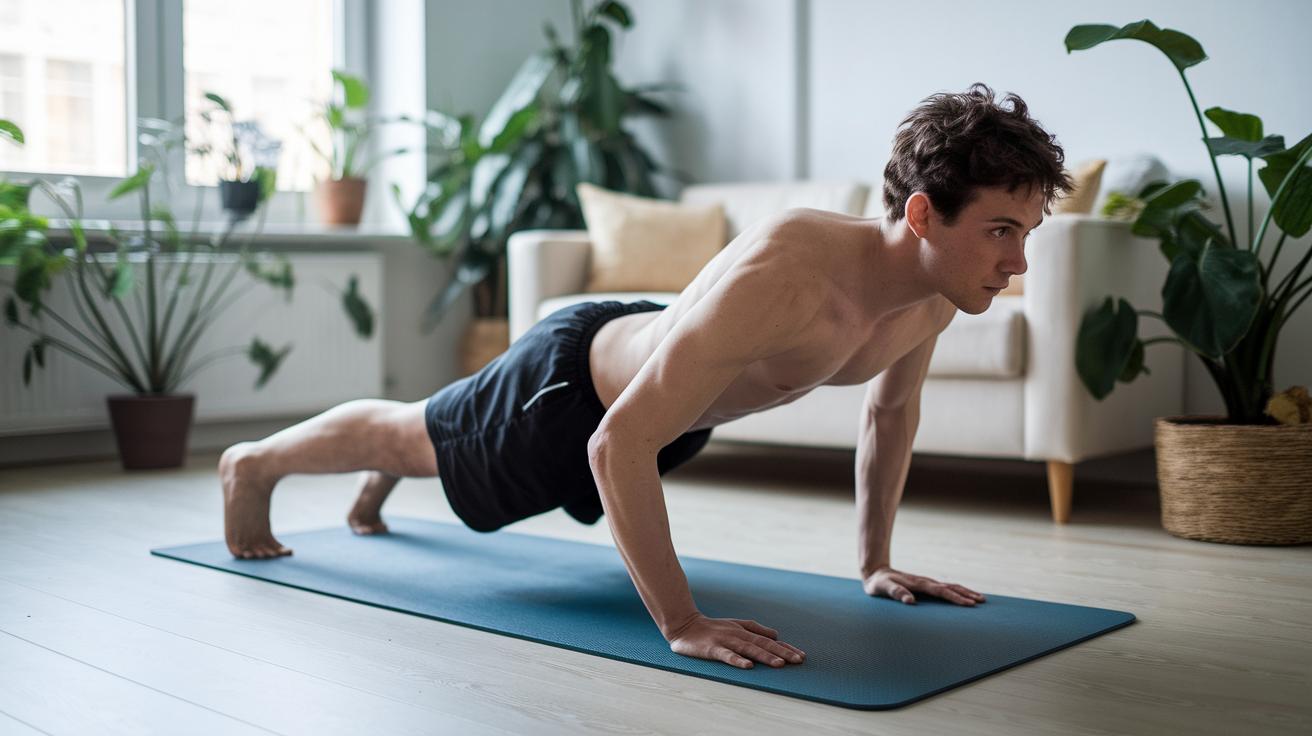
If you're a beginner in a small apartment, the fitness internet has a special talent for making you feel behind before you've done a single rep. The routines assume dumbbells you don't own, jumping your downstairs neighbor won't forgive, and a starting fitness level that looks suspiciously like the instructor's. So the tab stays open, the mat stays rolled, and "I'll start when I have proper equipment" quietly becomes the plan.
Now picture four weeks from tonight instead. You roll out a mat — or don't, the rug works — and move through a routine you know by heart: twenty quiet minutes, floor warm under your palms, nothing jumping, nothing clanking. Your push-ups have gone from wall to knees to a few proud full ones. Your legs feel the stairs less. You finish with that calm, slightly sweaty certainty that you did the thing. No equipment was involved in any of it. This plan is how that picture happens, week by week.
It's built entirely from the Tier 0 bodyweight principles in our tiny apartment home gym guide and follows the same silence rules as our silent apartment workouts: nothing leaves the floor, nothing is dropped, every rep is controlled.
The 8 moves (learn these and you know the plan)
- 1. Sit-to-stand (chair squat). Stand in front of a sturdy chair, feet hip-width. Sit back until you touch the seat, stand tall. Knees track over toes; the chair is your depth gauge and your safety net.
- 2. Wall → countertop → knee → full push-up. One movement, four levels. Pick the level where you can do clean reps with a straight line from head to heels (or knees). Level down with zero shame — form is the exercise.
- 3. Glute bridge. On your back, feet flat, drive the floor away and squeeze at the top for a full second. The quietest glute builder in existence, and the direct answer to desk-chair hips.
- 4. Bird dog. On all fours, slide one arm forward and the opposite leg back — slide, don't lift-and-drop. Your core learns to brace without your back doing anything dramatic.
- 5. Dead bug. On your back, arms up, knees at 90°. Lower opposite arm and leg slowly while your lower back stays glued to the floor. If the back arches, the range was too big.
- 6. Standing knee march. The silent cardio twin of jumping jacks: march tall, knees to hip height, arms swinging or reaching overhead. Faster = warmer. Nobody downstairs will ever know.
- 7. Calf raise. Both feet on the floor (or a book for range), rise slowly, pause, lower slower. Fingertips on a wall for balance. Desk workers' ankles send their regards.
- 8. Forearm plank (or wall plank). Straight line, ribs down, breathe. Start with 15–20 seconds of perfect instead of a minute of sagging.
The silence rules (they're what make this apartment-proof)
- Feet whisper: every step lands toe-first and quiet — if you can hear it, slow down.
- Nothing leaves the floor: no jumps, hops, or burpee landings anywhere in this plan, ever.
- Mat or rug under everything: even bodyweight work is quieter and kinder on a surface.
- Any hour is fine: because the plan is genuinely silent, 6 a.m. works as well as 6 p.m. (More in our noise guide.)
The 20-minute routine
Warm up with 2 minutes: easy knee marches, arm circles, 5 slow sit-to-stands. Then the circuit below, resting as needed. Cool down with 1–2 minutes of easy breathing and the wall chest stretch.
| Order | Move | Weeks 1–2 | Weeks 3–4 |
|---|---|---|---|
| 1 | Sit-to-stand | 8–10 reps | 12–15 reps (or no-hands) |
| 2 | Push-up (your level) | 6–10 reps | 8–12 reps (or one level harder) |
| 3 | Glute bridge | 10–12 reps | 15 reps + 2-sec squeeze |
| 4 | Bird dog | 5 / side | 8 / side |
| 5 | Dead bug | 4 / side | 6–8 / side |
| 6 | Standing knee march | 30 seconds | 45 seconds |
| 7 | Calf raise | 10 reps | 12–15 reps, slower lower |
| 8 | Plank (your level) | 15–20 sec | 25–35 sec |
How a session runs: do the circuit twice in weeks 1–2 (about 15–20 minutes with rests), three times in weeks 3–4 (about 22–25 minutes). Rest 30–60 seconds whenever form starts to fray — a clean shorter set beats a sloppy long one, always.
The 4-week schedule
| Week | Mon | Tue | Wed | Thu | Fri | Sat | Sun |
|---|---|---|---|---|---|---|---|
| 1 | Circuit ×2 | Walk/mobility | Circuit ×2 | Rest | Circuit ×2 | Walk/mobility | Rest |
| 2 | Circuit ×2 | Walk/mobility | Circuit ×2 | Rest | Circuit ×2 | Optional circuit | Rest |
| 3 | Circuit ×3 | Walk/mobility | Circuit ×3 | Rest | Circuit ×3 | Walk/mobility | Rest |
| 4 | Circuit ×3 | Walk/mobility | Circuit ×3 | Rest | Circuit ×3 | Retest day | Rest |
Retest day (end of week 4): write down your push-up level and clean reps, your plank time, and sit-to-stands in 60 seconds. Compare with week 1's numbers — that little notebook page is the most motivating piece of "equipment" you'll ever own, and it costs nothing and stores anywhere.
How to know it's working (and when to add gear)
Around week 3–4, most beginners feel the plan's ceiling approach on the big moves: push-ups at the hardest level for 12+, bridges feeling easy, planks stretching past 40 seconds. That's the graduation signal — the same one in our bands vs dumbbells comparison. The cheapest, quietest next step is a band set ($25–$60 typical) for rows and harder hinges; after that, adjustable dumbbells open the whole library. Plenty of people also simply run this plan's harder variations for months. Both paths are wins. The only losing move is waiting for equipment to start.
No-equipment workout FAQ
Can beginners actually get stronger with no equipment?
Yes. Beginners gain strength from effort and progressive challenge, and this plan progresses both: harder push-up levels, more reps, slower tempos, longer planks. You'll eventually outgrow bodyweight alone for maximum strength — around the time the retest numbers plateau — but the first months build real strength, muscle, and the habit itself, which is the part everything else depends on.
Is 20 minutes really enough?
For a beginner, 20 focused minutes 3 times a week is a genuinely effective dose — enough to improve strength, energy, and sleep without wrecking your schedule or your recovery. Consistency over 4 weeks beats one heroic hour. When 20 minutes feels easy to complete, that's your cue to use the week 3–4 progressions, not to double the session.
Will my downstairs neighbor hear this workout?
No — the plan is engineered for silence: no jumping, no dropped anything, feet landing toe-first on a mat or rug. Every movement keeps you in contact with the floor. It's the same design philosophy as our silent workouts library, and it's suitable for early mornings in most buildings.
What if I can't do a push-up yet?
Then you start at the wall — that's not a modified plan, that is the plan. Wall push-ups build the same muscles through the same pattern, and the levels (wall → countertop → knees → full) let you progress at exactly your pace. Nearly everyone who sticks with the levels for 4 weeks moves down at least one level.
What should I buy first when I'm ready for gear?
A thick mat if you don't have one, then a resistance band set with a door anchor — typically $25–$60 — for rows and harder leg work. When bands feel easy too, adjustable dumbbells are the long-term answer. Our bands vs dumbbells comparison walks through the order and the honest costs.
Health note: General fitness information for healthy adults, not medical advice. Beginners should build gradually, prioritize form over reps, and rest when form breaks down. Muscle soreness in the first week is common; sharp pain, joint pain, dizziness, or numbness is not — stop and, if symptoms persist, consult a qualified professional.
Keep the momentum: get the free Starter Checklist.
When this plan starts feeling easy, the checklist shows you exactly what to add, in what order, for a small apartment — gear, posture layer, and the weekly structure in one printable page. See what's inside.
One short email. No spam, no list-selling, unsubscribe anytime.

Written by Alex Rivera
Alex is an editor-reviewed persona created for Tiny Apartment Gym. This plan uses only well-established bodyweight progressions, scaled for beginners and engineered around one rule: if it's loud, it's out.